Elbow Reset Exercise: Eliminate Tennis Elbow and Golfer's Elbow
Your elbow aches on the outside (tennis elbow) or the inside (golfer's elbow). You can't grip without pain. Typing, lifting, even turning a doorknob hurts. You've tried rest, ice, compression braces, cortisone injections—but the pain keeps returning because the root cause remains: chronically fatigued forearm muscles that never get challenged in the opposite direction.
The elbow reset exercise works differently: it challenges your forearm muscles to twist against resistance in the direction they rarely work. This resistance rotation rebalances muscle tension, heals inflamed tendons, and eliminates elbow pain naturally. Regular brief practice over several weeks creates lasting relief.
Why Elbow Pain Happens: Tendinitis From Repetitive Fatigue
Tennis elbow (lateral epicondylitis) and golfer's elbow (medial epicondylitis) are both forms of tendinitis—inflammation of the tendons connecting your forearm muscles to your elbow. Here's how it develops:
The Anatomy of Elbow Tendinitis
- Forearm muscles (front and back): Control wrist and finger movements through twisting, flexing, and extending
- Tendons attach to the elbow: Outside tendons (lateral) connect to back forearm muscles; inside tendons (medial) connect to front forearm muscles
- Repetitive use creates fatigue: The same habitual movements (typing, gripping, swinging) overwork muscles in one direction
- Tendons become inflamed: Chronic muscle fatigue stresses the tendon attachment points, creating tendinitis
- Pain radiates: The elbow becomes the pain epicenter, but the problem originates in fatigued forearm muscles
Tennis Elbow vs. Golfer's Elbow
- Tennis elbow (lateral epicondylitis): Pain on the outside of the elbow from overworked back forearm muscles (extensors)
- Golfer's elbow (medial epicondylitis): Pain on the inside of the elbow from overworked front forearm muscles (flexors)
- Most people have lateral tennis elbow: Modern life (typing, gripping, phone use) overworks the extensor muscles constantly
The elbow reset addresses both by challenging forearm muscles to work in the opposite direction from their habitual patterns, breaking the fatigue cycle.
The Elbow Reset Mechanism: Resistance Rotation
The forearm's primary action is rotation—twisting inward and outward. Your daily movements constantly rotate your forearms in one direction (usually outward for typing, gripping). The elbow reset challenges your forearm to rotate in the opposite direction against resistance.
How Resistance Rotation Heals Tendons
When you twist your forearm against the resistance of your opposite hand:
- Fatigued muscles get challenged: The opposite rotation forces habitually overworked muscles to work differently, breaking the fatigue pattern
- Underused muscles activate: Muscles that rarely engage wake up and start sharing the load
- Tendon stress decreases: Balanced muscle tension reduces the constant pull on inflamed tendons
- Blood flow increases: Active resistance work brings fresh blood and nutrients to the area, promoting healing
- Connection strengthens: You develop a new neuromuscular connection to your forearm—it feels like a new arm
The Critical Rule: Equal and Opposing Forces
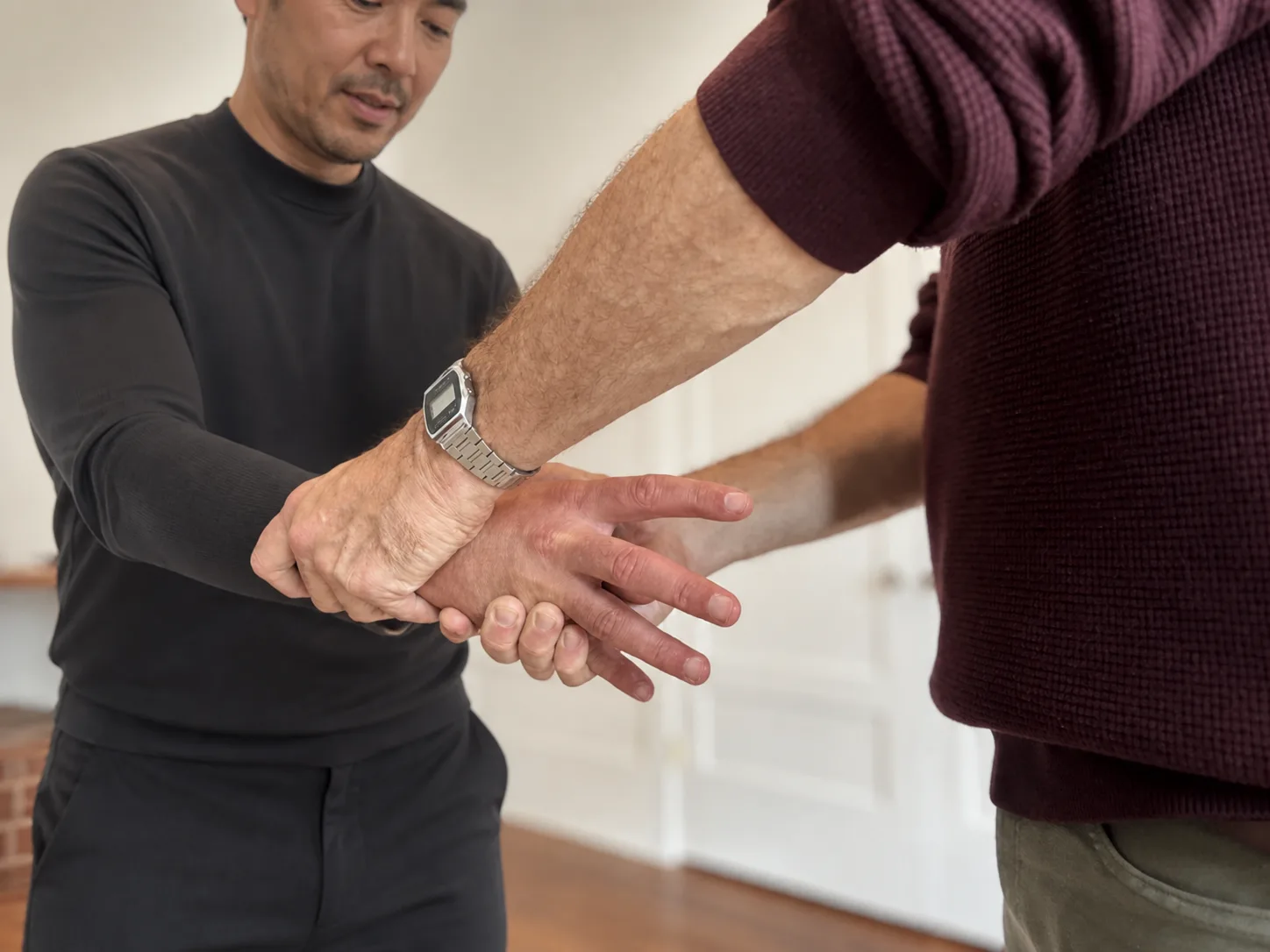
Like the jaw align and hand balancer, the elbow reset requires equal and opposing forces. The twisting working arm is in control—NOT the gripping hand. The gripping hand only matches the force the working arm produces.
If it hurts, you're gripping too hard. If you can twist more, grip more. If you can't twist that much, back off the grip. Perfect balance creates perfect results.
How to Do the Elbow Reset
The Basic Concept
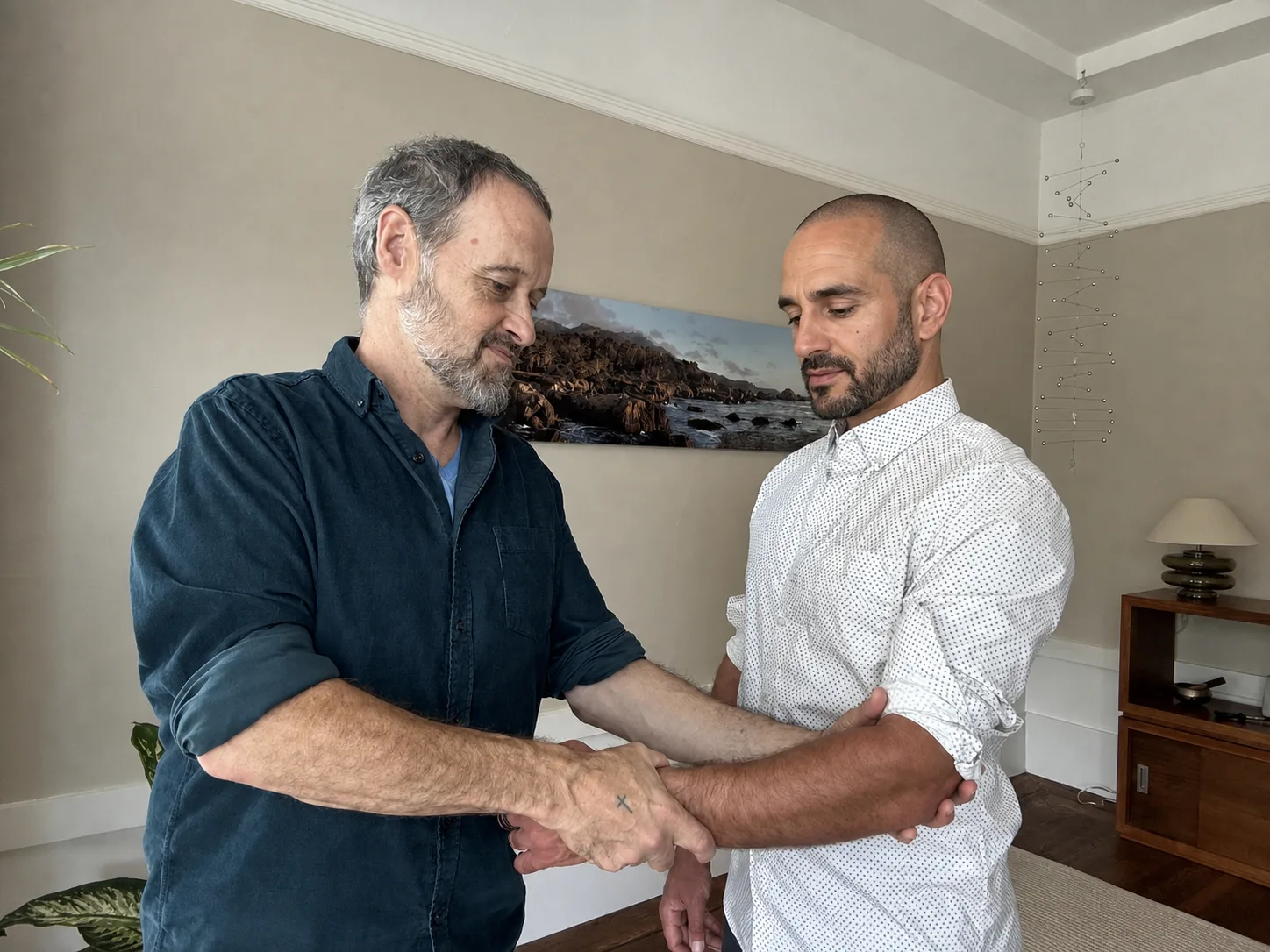
The elbow reset involves creating resistance between your working arm and opposite hand. Your working arm rotates against the gentle resistance of your gripping hand—this opposing force is what rebalances the muscles.
Outward rotation addresses tennis elbow (lateral pain), while inward rotation targets golfer's elbow (medial pain). Most people need the outward rotation variant.
The exercise requires brief holds with controlled breathing, alternating both arms and directions. The exact positioning, grip pressure calibration, and hold duration are critical—millimeters matter in hand placement, and most people apply too much or too little resistance without real-time correction.
Why Proper Instruction Matters
While the concept is straightforward, execution is sophisticated. Common mistakes include:
- Gripping too hard with the resisting hand (creating pain instead of relief)
- Gripping the hand instead of the wrist (wrong leverage point)
- Unequal force distribution between working arm and resisting hand
- Incorrect starting positions that reduce effectiveness
Dr. Garrett corrects these nuances in real-time during your first session, ensuring you learn the precise technique that creates results.
What People Experience With Elbow Reset
Immediate (During and Right After)
- Awareness of forearm tension you didn't know existed
- Feeling of a "new connection" to your forearm and elbow
- Muscles waking up in unfamiliar patterns
- Relief of tightness around the elbow
Short-Term (1-2 Weeks)
- Tennis elbow/golfer's elbow pain noticeably decreases
- Gripping becomes easier and less painful
- Typing, lifting, and daily tasks hurt less
- Forearm feels more balanced and capable
Medium-Term (2-4 Weeks)
- Elbow pain largely or completely resolves
- Tendons no longer inflamed or tender
- Full range of motion returns without pain
- Forearm strength increases noticeably
Long-Term (30+ Days)
- Complete elimination of tennis elbow or golfer's elbow
- Elbow feels strong, stable, and pain-free
- Only need elbow reset occasionally when forearm feels fatigued
- Ability to do activities that previously caused pain (tennis, golf, typing, lifting)
Common Mistakes and How to Avoid Them
Mistake 1: Gripping Too Hard
The Problem: Just like with hand balancer, people squeeze their wrist too hard with the gripping hand, causing pain.
The Fix: Remember—the twisting working arm is in control, not the gripping hand. Perfect equal and opposing forces. If it hurts, reduce your grip pressure.
Mistake 2: Not Gripping Enough
The Problem: The opposite—twisting too much with no counterforce from the gripping hand, which doesn't challenge the muscles.
The Fix: Match the twist force with grip resistance. You should feel your forearm muscles working hard against resistance.
Mistake 3: Gripping Too Low (On the Hand Instead of Wrist)
The Problem: Gripping the hand instead of the wrist doesn't provide stable resistance for the forearm rotation.
The Fix: Fully grip the wrist—your hand should wrap completely around the wrist, not the hand.
Mistake 4: Skin Pulling and Tugging
The Problem: The gripping hand tugs and pulls on the skin, causing irritation that distracts from the exercise.
The Fix: First, try making more contact with the palm of the gripping hand (fuller grip). If still pulling, cover the wrist with a piece of cloth or wear a glove on the gripping hand to prevent skin irritation.
FAQ: Elbow Reset Exercise
How do I know if I need outward or inward rotation?
Most people need outward rotation (for tennis elbow). If you have pain on the outside of your elbow, focus on outward rotation. If you have pain on the inside of your elbow (golfer's elbow), focus on inward rotation. You can do both directions to cover all bases—it only adds 30-40 seconds.
Can I do this if I have severe tennis elbow pain?
Yes, but start gently. Use very light grip resistance—just enough to feel your forearm muscles working without pain. As your tendons heal over the first week, you can gradually increase resistance. If sharp pain occurs, reduce grip force immediately.
How long does it take to see results?
Tendinitis is chronic inflammation from months or years of fatigue. It takes consistent regular practice over several weeks to fully rebalance muscle patterns, heal tendons, and break the fatigue cycle. The exact practice frequency and duration progression are taught during your first session based on your severity level.
Will this work if cortisone injections didn't?
Yes. Cortisone injections reduce inflammation temporarily but don't address the root cause (fatigued, imbalanced forearm muscles). The elbow reset rebalances the muscles causing the tendon stress, eliminating the problem at its source.
Can I do this while wearing a tennis elbow brace?
You can, but as your elbow heals with the reset exercise, you'll likely find you don't need the brace anymore. Braces provide external support but don't fix the internal muscle imbalance. The elbow reset creates internal stability.
How is this different from physical therapy exercises?
Traditional PT focuses on stretching and eccentric strengthening. The elbow reset uses resistance rotation to challenge muscles in the opposite direction from habitual patterns. It's isometric (no movement, just force), which creates neuromuscular rebalancing more efficiently.
Master the Complete Elbow Reset System
This article explains WHY the elbow reset works and the biomechanics behind resistance rotation. The EXACT grip pressure calibration for your specific anatomy, precise hand positioning (millimeters matter), breathing synchronization, and progressive protocols for severe cases require hands-on guidance.
Professional Guidance Makes the Difference: Most people do this incorrectly without real-time feedback. Dr. Garrett teaches the precise technique that creates lasting results in your first session.
→Learn the Complete Elbow Reset System →Schedule Free Discovery CallKey Takeaways
- Tennis elbow and golfer's elbow are tendinitis—inflammation from chronically fatigued forearm muscles
- Resistance rotation challenges muscles in the opposite direction, breaking the fatigue cycle
- Equal and opposing forces are critical—the working arm leads, the gripping hand only matches
- Outward rotation addresses tennis elbow (outside elbow pain)—this is what most people need
- Inward rotation addresses golfer's elbow (inside elbow pain)—less common but effective
- Brief regular practice over several weeks creates lasting relief
- Creates a "new connection" to your forearm—neuromuscular rebalancing that eliminates pain at the source