Knee pain can narrow your day one movement at a time. You take stairs cautiously, shorten a walk or think twice about getting back on your bike. The question becomes how to keep doing what matters without repeating the same painful movement.
In Amari, Garrett pays attention to the knee and to how your hip, ankle and foot take part in the movement. That broader view gives him more ways to guide you toward less pain and freer movement. It does not mean the knee can be ignored or that every painful knee has the same cause.
Start with the activity, not a theory
Stairs, walking and cycling are not interchangeable. Your knee bends and straightens in all of them, but the support, pace and effort are different.
Describe the part that is difficult. Is it the first few steps, a longer walk, going up or coming down? Does the movement feel restricted, painful or difficult to control? Does the problem change as you continue?
You do not need to decide what those answers mean medically. They give you a clearer way to explain the problem and a useful reference for noticing whether the work helps.
The knee works between the hip and the foot
When you stand and move, your leg is not a collection of separate exercises. Your foot meets the ground, your ankle moves and your hip takes part above the knee.
Looking at the whole leg gives us more to work with when a step hurts. Changing how the feet and ankles take part, or how the rest of the body is supported, may change the effort around the knee. What matters is whether the movement becomes less painful or easier to control.
That is more useful than assuming a painful knee must always need stronger thighs, more stretching or a particular foot position. Those choices depend on the person and on any medical guidance they have received.
What the Spring Step adds to the picture
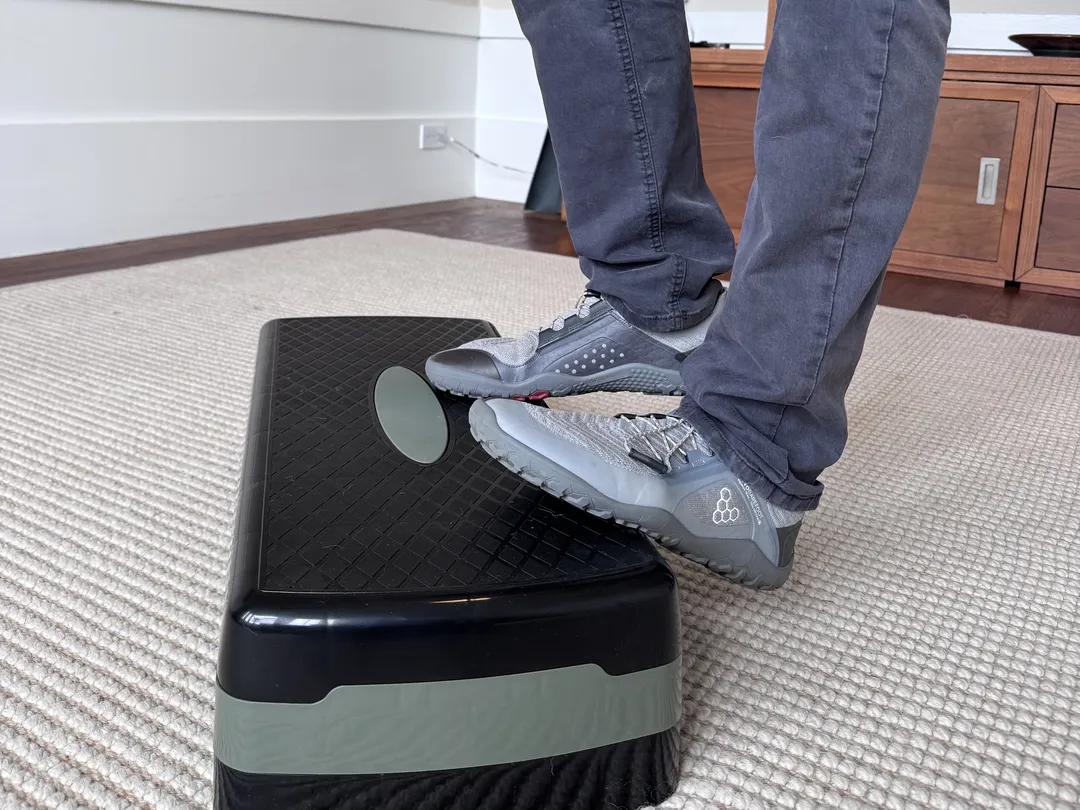
The Spring Step article is about the feet, calves and ankles, but its place in the practice is broader than loosening a calf.
Garrett teaches it as a movement with rhythm and changing effort, rather than a static position held for a fixed count. He pays attention to foot placement and how the person carries the rest of the body while moving. The same outward position can be done with different amounts of strain and engagement.
For someone working on knee pain, that makes the foot and ankle worth paying attention to. It is not a claim that Spring Step is the answer to every knee problem. It is one possible part of a practice chosen around what the person needs.
Read the Spring Step article for more about the movement.
Keeping a joint soft is different from giving up support
One recurring instruction in Garrett's sessions is to avoid locking a joint while finding engagement elsewhere. In Power Posture, for example, he asks for softer knees while the person works around the shoulder blades. He also discusses slowing down during walking to notice whether the knees are locking. The pace gives the person time to feel how they are moving, rather than hurry through a familiar pattern.
The lesson carries through the practice: active does not have to mean rigid. You can learn to recognize useful effort without bracing everything at once. Likewise, relaxing does not have to mean dropping out of the movement completely.
If you are constantly protecting a painful knee, it can be hard to tell useful effort from bracing. We work on finding support without asking you to hold the whole leg rigid. If a movement strains the knee or another area, the setup changes; the strain is not a target to endure.
Measure progress against the things you want back
A substantial change in pain or restricted movement can happen in a first session. Continued work gives you time to build on it and become more confident using the practice yourself.
Keep the ordinary activities in view. Is going downstairs easier? Can you walk farther without the pain building, or get back on your bike more comfortably? Those are useful ways to judge progress alongside what you feel during the guided movements.
When knee pain needs medical care
Seek urgent medical advice if you cannot move the knee or bear weight, it is badly swollen or misshapen, it locks or gives way, or it is hot and red with a high temperature. Pain that persists also needs medical advice. The NHS knee-pain guidance explains these signs in more detail.
Amari does not diagnose or treat medical conditions. If guided movement is appropriate for you, learn about working on knee pain in an Amari Assessment.