When turning your head hurts, even ordinary things start taking more effort. You turn your whole body to look over your shoulder. You keep changing position at your desk. By the evening, you are trying to relax a neck that has felt busy all day.
It is tempting to search for the one position that will keep it from happening. Chin in, shoulders back, sit taller. But a position you can hold for thirty seconds is not necessarily a comfortable way to spend the day.
Amari helps people reduce neck pain and move more freely through guided movement. We pay attention to your neck, but also to what your shoulders, arms and upper back are doing while you move. That gives us more to work with than asking you to keep your head in the right place.
Start with the movement you want back
A stiff turn to the left, an ache after computer work and discomfort when looking up are different problems to live with. Being able to look over your shoulder matters more than holding a posture that looks correct.
Notice which movements feel limited, when the discomfort builds and what makes it easier. You do not need to identify a muscle or decide what is causing it before asking for help.
It also gives you something specific to compare after guided work. The question is whether turning, looking or moving feels different, not whether you can copy a better-looking posture in the mirror.
Your neck does not move by itself
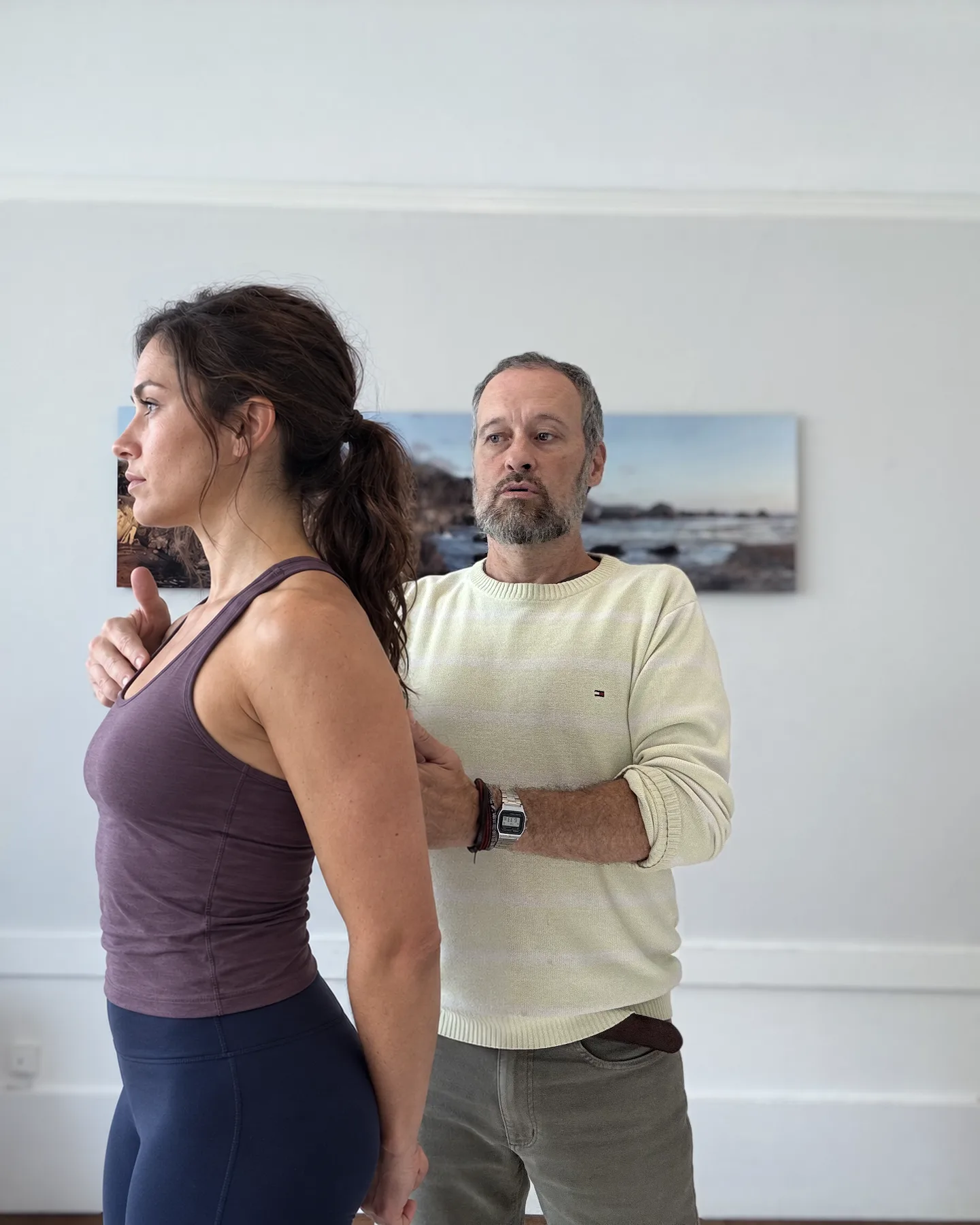
Your head sits above your upper back, with your shoulders and arms moving around it. In Amari, Garrett looks at those relationships while you move. Can you find some engagement around the shoulder blades without tightening everything else? Does supporting your arms change the effort you feel around your neck? What happens when the movement is slower?
These are practical questions about your response. A change in one position can help us choose what to do next. It does not prove that everyone with neck pain has the same shoulder-blade problem.
Power Posture is one example of this approach. The work involves the shoulder blades and breath, with attention to keeping other joints from locking. Garrett adjusts the position rather than asking you to pull your shoulders back as hard as possible.
Read more about Power Posture.
More engagement does not mean more tension everywhere
A useful distinction in Garrett's teaching is between being active and becoming rigid. You can put effort into one part of a movement while allowing another part to soften. The aim is to feel supported without constantly pulling your shoulders back or holding your neck in place.
In a session, he may change the position of your arms, use hands-on guidance or slow the movement so you can feel that difference. Your feedback matters. If the change makes you brace harder or strains your neck, that is information for adjusting the work, not a reason to push through.
This is also why two people who describe the same neck tension may start differently. One may need help finding an action. Another may need to do less, or use more support, before that action becomes comfortable.
What to carry into the rest of your day
The aim is relief you can build on, with movements you gradually learn to use yourself. At first, it can be hard to notice a familiar habit while you are doing it. Garrett helps you recognize the difference between the movement you came in with and one that feels easier. That gives you something more useful to carry into your day than another posture to hold perfectly.
As you become familiar with the work, you can recognize when you are tightening your whole upper body and which movements help you release that effort. The useful result is being able to turn, look up or finish your workday with less pain. Further sessions build toward those changes and help you use the practice yourself.
When to get your neck checked
Neck pain has different possible causes. Seek medical advice if it persists, worries you or comes with other symptoms such as pins and needles or a cold arm. Do not drive or cycle if you cannot turn your neck safely. NHS guidance on neck pain explains when to get help.
Amari does not diagnose or treat medical conditions. For pain and restricted movement that are appropriate for guided movement, you can start with a private Assessment in San Francisco.